October 7th, 2026AD
For several minutes Tuesday night, Granbury City Attorney Jeremy SoRelle explained why the City Council would eventually have to order a recall election.
The five targeted officials had received the petitions. Public hearings had been held. None had resigned.
“The charter requires us to order a recall election,” SoRelle told the council.
Then he put it even more plainly:
“It’s not really optional. You will have to order the recall election.”
Granbury’s charter says that if an official targeted for recall does not resign, it becomes the duty of the City Council to order an election for the earliest date permitted by state law.
But Tuesday night, the City did not continue toward that election.
Minutes before SoRelle made those comments, a veteran Texas election lawyer from Brenham had unexpectedly stepped to the podium.
His name was Andy Taylor.
Taylor announced that he had filed a lawsuit against the City of Granbury seeking to invalidate all five recall petitions.
And by the end of the discussion, SoRelle was recommending that the City stop.
That sequence has opened a new chapter in Granbury’s months-long recall fight — and raised a question the Hood County Express has spent the last several hours investigating:
Who brought Andy Taylor to Granbury?
So far, HCE has not found the answer.
What we have found is a series of documented relationships connecting Taylor to former state Sen. Brian Birdwell, Birdwell to Granbury City Manager Chris Coffman, and Birdwell’s wife, Mel, to several of the local figures now surrounding the recall controversy.
Those relationships do not prove that any of them hired Taylor, referred the case to him or arranged his appearance at City Hall.
But they are documented, and they provide a legitimate trail for further reporting.
ANDY TAYLOR ARRIVES
At the outset of the recall discussion Tuesday, council members were told that information about a potential lawsuit had been received immediately before the meeting.
Officials then noted that the man who had filed the lawsuit had also submitted a speaker card.
The council changed the order of business.
Taylor approached the microphone.
He described himself as an election lawyer with 39 years of experience and acknowledged that his career has often placed him on the side of citizens exercising their right to petition government.
“Normally, I’m on the side of the citizens’ right to petition government for a perceived redress of grievances,” Taylor said.
“But that’s not why I’m here.”
Taylor said the five recall petitions had been “studied carefully” and then leveled a series of serious allegations.
He alleged that some petition signatures were forged.
Others, he said, had been copied from one petition to another.
Taylor alleged that some signatures had been digitally manipulated, “probably with AI technology.”
He also challenged how petition circulators obtained signatures, including whether circulators were personally present when signatures were made and whether residents understood that the documents they were signing were recall petitions.
Taylor offered one example.
If the goal was to recall five council members, he said, a circulator could not simply approach a resident by asking whether the person opposed data centers and then ask for a signature without explaining the actual purpose.
Taylor characterized that conduct as fraudulent.
He then announced:
“I have filed a lawsuit against the city asking the judicial branch of government to find that these petitions are invalid.”
Taylor did not identify a plaintiff during his remarks.
He did not say who retained him.
He did not identify who is paying his legal fees.
And he did not explain who first contacted him about Granbury.
THE CITY CHANGES COURSE
After Taylor and another speaker finished, SoRelle addressed the recall-election item.
He first laid out why the process had reached the election stage.
The targeted officials had been served.
Public hearings had been held.
None had resigned.
The council therefore would have to order the recall election.
SoRelle said he expected that could happen at the next meeting or the meeting after.
Then, after describing the election order as mandatory, he changed direction.
“In light of the information that I received prior to the meeting and Mr. Taylor’s comments there,” SoRelle said, “I think it’s probably in the best interest of the city that we stop there with this, due to the pending litigation.”
As of HCE’s reporting cutoff Wednesday morning, we had not located a publicly available temporary restraining order, injunction, stay or other judicial order directing Granbury to stop the recall process.
A lawsuit had been announced. Whether a judge had separately restrained the City from proceeding remained unclear.
The public record available to HCE showed that Granbury paused after learning of Taylor’s litigation and hearing his presentation.
A WARNING SIGN ONE WEEK EARLIER
One part of Taylor’s argument had already surfaced publicly.
At the September 28 recall hearings, Granbury resident Sally Walther told the council that she believed she had signed one petition involving concerns about data centers.
“I signed one petition,” Walther said.
“I did not sign five petitions.”
Walther said she believed she had signed a petition to obtain more information about data centers and later learned that her signature appeared on all five recall petitions.
A week later, Taylor stood before the same council and alleged that residents had been solicited through opposition to data centers without being adequately informed that they were signing recall petitions.
The overlap between the two accounts is clear.
What remains unknown is whether Walther ever communicated with Taylor, supplied information to him, signed an affidavit, retained him or had any role in his entry into the dispute.
HCE has found no evidence establishing such a connection.
Another resident, Jim Jones, followed Taylor at the microphone Tuesday night.
Jones said he also had previously been approached over the data-center controversy and asked to sign a petition without, according to his account, being told that the effort involved a mass recall.
Jones openly described his relationships with several people on the city side of the dispute. He said Mayor Pro Tem Bruce Wadley had been his neighbor for 11 years, Councilman Skip Overdier had served with him on an HOA board and he had experienced favorable dealings with Coffman.
Jones’ comments provide another public account of petition solicitation framed around data centers.
They do not establish that Jones had anything to do with Taylor’s lawsuit.
WHO IS ANDY TAYLOR?
Taylor is not a local attorney making his first venture into election law.
His firm advertises substantial experience in election, political and public-policy litigation.
Taylor has operated for decades at the highest levels of Texas Republican politics. He served as First Assistant Attorney General under John Cornyn, personally represented George W. Bush during the 2000 Florida recount, and his firm publicly lists national Republican organizations and numerous prominent Texas officeholders among its clients.
In 2016, Taylor appeared before the Texas House Committee on Elections advocating stronger protections for citizens trying to petition local governments.
His stated objective included helping “level the playing field” between powerful local governments and ordinary voters.
Taylor acknowledged that history Tuesday night rather than avoiding it.
His position in Granbury appears to be that citizen petition rights deserve protection, but these particular petitions are invalid because of the conduct he alleges occurred during their circulation.
The merits of those allegations have not been determined by a court.
A FAMILIAR NAME ON TAYLOR’S CLIENT LIST
HCE’s review of Taylor’s own law-firm records produced an immediate Hood County connection.
Andy Taylor & Associates publicly lists former Senate District 22 state Sen. Brian Birdwell among its clients.
Birdwell represented Granbury and Hood County for years before leaving the Texas Senate earlier this year. He now serves in the Trump administration as Assistant Secretary of War for Sustainment.
HCE has not yet identified the matter in which Taylor represented Birdwell.
We do not know when that representation began, when it ended, what work Taylor performed or how it was paid for.
And we have found no evidence showing that Birdwell contacted Taylor about the Granbury recall case.
But Birdwell also has a documented relationship with Coffman.
In a November 2025 Hood County News report, Birdwell discussed working closely with the Granbury city manager and said:
“Chris and I have had a lot of conversations.”
That gives HCE two established relationships:
Andy Taylor has represented Brian Birdwell.
Brian Birdwell has worked closely with Chris Coffman.
The missing piece is whether those relationships had anything to do with Taylor’s arrival Tuesday night.
THE LOCAL NETWORK
The relationships extend beyond Birdwell and Coffman.
Federal nonprofit records for the Hood County Committee on Aging show that Mel Birdwell and Coffman served together as directors during the organization’s fiscal year ending in 2021.
Later records show Mel Birdwell serving within the same civic organization alongside City Attorney Jeremy SoRelle and recall target Skip Overdier.
Those records establish that several people now appearing in different roles around the recall fight have longstanding civic relationships in Hood County.
They do not establish that the nonprofit had anything to do with Taylor’s lawsuit.
They do not establish that Mel Birdwell contacted Taylor.
They do not establish that SoRelle, Coffman or Overdier coordinated Taylor’s appearance.
For now, the records show a network of existing relationships — nothing more.
PRIVATE ATTORNEYS WERE ALREADY ON THE TABLE
Another piece of the timeline predates Taylor’s appearance.
Weeks earlier, Coffman had been recorded discussing the choices available to the officials facing recall.
Among those possibilities was retaining private attorneys to continue challenging the process.
Coffman estimated that private legal representation could cost roughly $10,000 per official.
The recording does not identify Taylor.
It does not show Coffman selecting an attorney or recommending one.
But it establishes that continued private legal action against the recall process had already been contemplated before Taylor appeared at City Hall.
Taylor’s remarks Tuesday also indicate that his involvement did not begin that evening.
He said “we” had “studied carefully” all five recall petitions.
Someone had obtained the petitions.
Someone had provided or gathered the information Taylor relied upon.
And enough legal work had already occurred for Taylor to tell the council that a lawsuit had been filed.
Exactly when that work began — and at whose request — remains unknown.
THE CITY HAD ALREADY REVERSED COURSE ONCE
This is not the first legal turn in the recall fight.
Granbury initially rejected the recall petitions.
Recall organizers Daniel Piatt and Janet Logsdon then sought mandamus relief from the Second Court of Appeals.
The City later changed course and agreed to move the petitions forward through the charter process.
On September 21, the appellate court denied the mandamus petition as moot.
The court’s published opinion does not contain a merits ruling declaring that Granbury had fully complied with Chapter 277 of the Texas Election Code or that the petitions themselves were valid. It states that the requested mandamus relief had become moot.
The process then moved to the September 28 public hearings.
None of the targeted officials resigned.
By Tuesday night, SoRelle said the City had reached the point where the council would have to order the election.
Then Taylor appeared.
WHAT HCE CAN DOCUMENT
At this point, HCE has established the following:
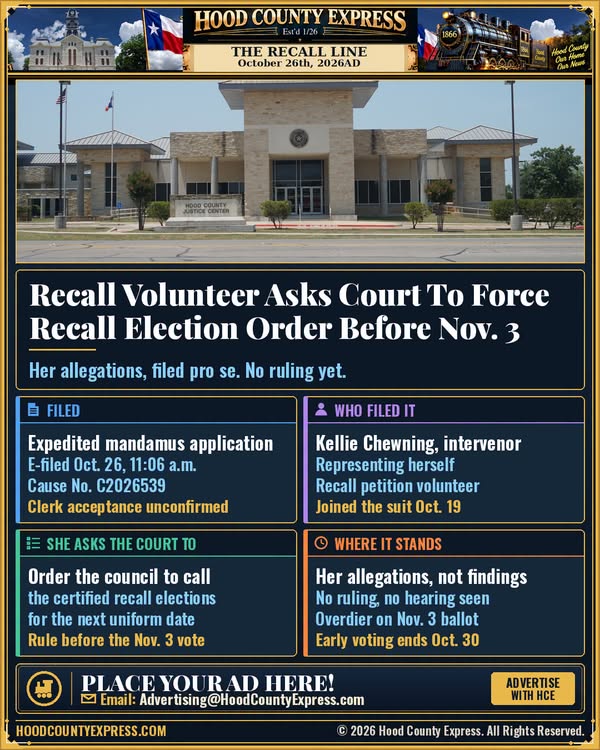
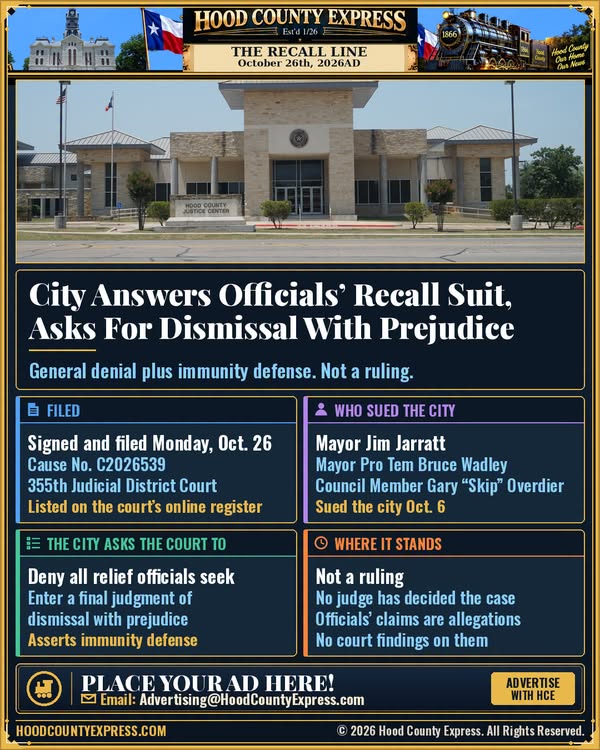
Andy Taylor says he filed litigation seeking to invalidate all five Granbury recall petitions.
Taylor’s own law firm publicly identifies Brian Birdwell as a client.
Birdwell has a documented working relationship with Coffman.
Public nonprofit records establish civic-board relationships involving Mel Birdwell, Coffman, SoRelle and Overdier.
Sally Walther publicly described a petition-signing experience one week before Taylor raised a similar allegation before the council.
Coffman had previously discussed private legal representation as one possible path for officials seeking to continue challenging the recall.
And after Taylor announced the lawsuit Tuesday night, SoRelle recommended that the City stop moving forward with the recall-election item.
There are equally important things HCE has not established.
We have not established that Birdwell contacted Taylor.
We have not established that Mel Birdwell contacted Taylor.
We have not established that Coffman or SoRelle contacted Taylor.
We have not established that any of the five targeted officials retained Taylor.
We have not established that Sally Walther contacted Taylor.
We do not yet know who is paying Taylor.
And as of this reporting cutoff, HCE had not located a publicly available judicial order directing Granbury to stop the recall process.
THE QUESTION REMAINS
Taylor did not walk into Granbury City Hall Tuesday night unfamiliar with the case.
By his own account, the five petitions had already been carefully studied.
Detailed accusations had already been developed.
A lawsuit had already been prepared and, Taylor said, filed.
The question now is how that process began.
Who contacted him first?
Who asked him to review the petitions?
Who supplied the material used to develop the allegations?
Who is the plaintiff?
Who is paying the legal bill?
And did anyone connected to Granbury City Hall know in advance that Taylor was coming?
The Hood County Express is continuing to trace the court filings, communications, relationships and money surrounding the lawsuit.
We will report what the records show — and just as importantly, what they do not.
For now, one question remains at the center of the investigation:
Who brought Andy Taylor to Granbury?
— Hood County Express
Est’d 1/2026 🚂
© 2026 Hood County Express. All Rights Reserved.